Rarest First Names in America (And What They Mean)
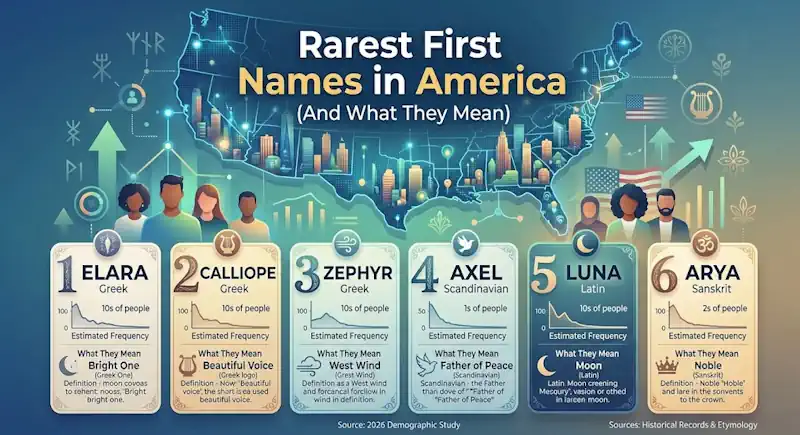
While names like Olivia and Liam dominate hospital name tags year after year, thousands of parents go the opposite direction entirely, choosing first names so uncommon that only a handful of babies in the whole country will ever share them. Here is a closer look at how rare first names are tracked, what makes a name statistically unique, and the stories and meanings behind some of the most uncommon choices.
Quick Answer
The rarest first names in America are typically given to fewer than five babies per year, the threshold at which the Social Security Administration stops publishing exact counts to protect privacy. This includes invented names, revived historical names, names borrowed from other languages, and creative spelling variations of otherwise common names.
How Rare First Names Are Actually Measured
Every year, the Social Security Administration releases a list of first names given to babies born in the United States, based on Social Security card applications. This dataset goes back to 1880 and is the primary source nearly every name popularity tool relies on, including ours.
For privacy reasons, the SSA does not publish exact counts for any first name given to fewer than five babies in a given year. Once a name drops below that threshold, it effectively disappears from public rankings even though real children are still receiving it. This means the truly rarest names in the country are, by definition, invisible in official statistics. What we can study instead are names that sit just above that cutoff, typically given to somewhere between five and fifty babies nationwide in a single year.
Categories of Rare First Names
Rare names tend to fall into a few recognizable patterns rather than being completely random.
Invented names. Some parents combine sounds, blend two existing names, or create something entirely new. These names often have no traditional meaning at all, since the meaning comes from the intention behind creating them rather than linguistic history.
Revived historical names. Names common a century or more ago sometimes fall so far out of use that they become rare again, then occasionally get revived by parents drawn to a vintage or old-fashioned feel. A name that was common among great-grandparents can feel completely fresh to a new generation.
Names borrowed from nature or place. Words like river, season names, or geographic terms used as first names tend to stay rare because they were never part of traditional naming conventions in English speaking communities.
Names from other languages and cultures. A name can be extremely common in one country and statistically rare in the United States simply because it has not been widely adopted here yet, regardless of how popular it is elsewhere.
Unusual spelling variations. Splitting a common name into an uncommon spelling, such as replacing standard letters with alternate ones, can push an otherwise popular name into rare territory purely based on how it is spelled on the birth certificate.
Examples of Rare Names and Their Meanings
Below are a few examples of names that have appeared near the rare end of recent SSA data, along with what they mean or where they come from. Exact yearly counts fluctuate, so treat these as illustrative rather than fixed rankings.
| Name | Origin | Meaning |
|---|---|---|
| Wrenley | Modern invented, based on the bird name Wren | Associated with the small, energetic bird, often chosen for a nature-inspired feel |
| Soren | Scandinavian | Derived from a Latin name meaning stern or severe |
| Marlowe | English surname turned first name | Historically meant driftwood or remnants of a lake, now used as a stylish unisex choice |
| Ottoline | French, diminutive of Otto | Associated with wealth and prosperity, revived as a vintage-style name |
| Zephyrine | Feminine form of Zephyr | Rooted in Greek mythology, referring to the west wind |
| Casimir | Slavic | Traditionally means one who destroys peace, historically used among Polish royalty |
Why Some Parents Choose Rare Names on Purpose
Interest in rare names has grown noticeably over the past decade. A few common motivations show up again and again among parents who deliberately search for uncommon options.
- Wanting their child to stand out rather than share a name with several classmates
- Connecting to a specific cultural, family, or linguistic heritage that is not widely represented
- Preferring names that carry a specific meaning over ones chosen purely for popularity
- Avoiding names strongly associated with a particular decade or trend
At the same time, rare names come with practical tradeoffs. Uncommon spellings can lead to frequent mispronunciation or misspelling throughout a person’s life, and extremely unique names can occasionally draw more attention than a child wants growing up.
Rare First Names Versus Rare Full Names
It is worth separating two different ideas that often get confused. A first name can be common on its own but still result in a rare full name when paired with an uncommon last name, and the reverse is also true. A name like Emma is extremely common by itself, yet Emma paired with a rare surname can still produce a full name combination shared by only a handful of people nationwide. If you are curious where your own full name lands, checking both parts separately tends to give a clearer picture than assuming rarity based on the first name alone.
Final Thoughts
Rare first names sit at an interesting intersection of personal creativity and measurable statistics. Behind every uncommon name is either a deliberate choice, a cultural connection, or simply a name that has not caught on yet, and tracking these patterns offers a genuinely interesting window into how naming trends shift from one generation to the next.
Frequently Asked Questions
Names given to fewer than roughly fifty babies nationwide in a given year are generally considered rare, with anything under five falling below the threshold the Social Security Administration publicly reports.
Yes. Many names cycle in and out of popularity over decades. A name that is rare today can become common within a generation if enough parents adopt it, and previously popular names regularly fade into rarity.
Sometimes. Invented or blended names may not have a traditional meaning at all, while names borrowed from other languages or revived from history usually do have documented origins.
Not necessarily on its own. A rare first name paired with a common last name can still result in a fairly common full name, and the opposite pairing is also possible.
You can search your exact first and last name using our name rarity tool to see an estimated percentile based on current Census and SSA data.
Curious how rare your own name is?
See how many people in the US share your first and last name — free, instant, nothing stored.
Try the name tool