How Many People Share Your Exact Full Name? Here’s How It’s Calculated
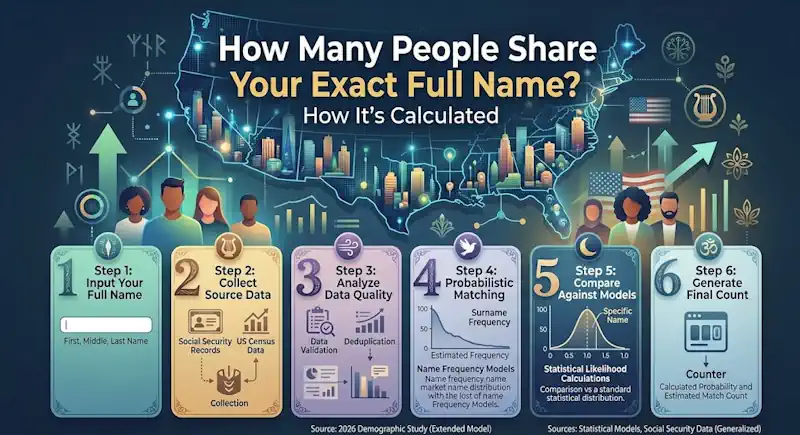
Type your name into a name frequency tool and you get a single number back in seconds. What actually happens behind that number is a genuinely interesting piece of applied statistics, built on two separate government datasets that were never designed to work together in the first place. Here is exactly how full name frequency estimates are calculated, and why the number you see is an estimate rather than an exact count.
Quick Answer
No single government database records exact first and last name combinations for privacy reasons, so full name frequency is estimated by combining two separate datasets. First name frequency comes from Social Security Administration birth records, and last name frequency comes from US Census Bureau surname files. These two numbers are combined using a statistical method called independence multiplication, then scaled against the current US population.
Why There Is No Direct Database to Check
It would seem logical for the government to simply keep a list of every full name and how many people have it. That list does not exist publicly, and for good reason. Combining first and last names with any other identifying detail starts to look like a searchable directory of real individuals, which raises serious privacy concerns. Both the Census Bureau and Social Security Administration intentionally publish first names and last names as separate, anonymized frequency tables rather than combined records, specifically to prevent this kind of individual identification.
This is exactly why every legitimate name frequency tool, including ours, has to reconstruct an estimate rather than pull a real number from a single source.
The Two Data Sources Behind Every Estimate
Social Security Administration birth records. The SSA has published first name data going back to 1880, based on Social Security card applications. This dataset shows how many babies were given a specific first name in a specific year, broken down by sex. It is the foundation for understanding how common any first name is among people currently alive, once adjusted for mortality and age.
US Census Bureau surname files. Roughly every ten years, the Census Bureau releases a count of how many people reported each last name during the national census. This is the most authoritative source for last name frequency, though it only covers surnames shared by 100 or more people for privacy reasons, meaning extremely rare last names are not individually listed.
The Actual Calculation, Step by Step
Here is the process most name frequency tools follow to turn these two separate datasets into one combined estimate.
Step 1: Calculate the first name frequency rate. The tool determines what percentage of the living population has the given first name, based on cumulative SSA birth data adjusted for people still alive today using standard life expectancy tables.
Step 2: Calculate the last name frequency rate. Using Census surname files, the tool determines what percentage of the population has the given last name, expressed as a rate per 100,000 residents.
Step 3: Multiply the two rates together. This step relies on an assumption called statistical independence, meaning the tool assumes a person’s first name and last name are not related to each other. In reality this is not perfectly true, since certain first names are more common within certain cultural or ethnic groups that also share certain surnames, but treating them as independent produces a reasonable estimate for the vast majority of name combinations.
Step 4: Multiply the combined rate against the current US population. Once the combined percentage is calculated, it gets multiplied by the total living US population to produce a final estimated headcount for that exact full name.
A Simplified Example
Imagine a first name that exactly 1 in every 120 Americans has, and a last name that exactly 1 in every 800 Americans has. Multiplying those two rates together produces a combined rate of roughly 1 in 96,000 people sharing that specific first and last name combination. Applying that rate to a population of around 342 million people produces an estimated headcount of a little over 3,500 people nationwide.
This is a simplified version of the math, but it captures the core logic every tool in this space relies on, including the more detailed versions that also factor in age distribution and regional variation.
Where the Estimate Can Be Less Accurate
No calculation method is perfect, and it helps to understand where the assumptions can break down.
Cultural and ethnic name correlation. Certain first names are strongly associated with specific cultural or ethnic groups that also carry specific surnames more often than random chance would suggest. A name combination that is culturally coherent, meaning the first and last name commonly appear together in real life, is often more common than the independence assumption predicts. A combination that would be culturally unusual is often rarer than the math suggests.
Data suppression for very rare names. Both the SSA and Census Bureau suppress exact figures for names below certain thresholds to protect privacy. When either the first name or last name falls into this suppressed range, the tool has to estimate using the lowest known bound rather than an exact figure, which introduces more uncertainty for unusual name combinations.
Regional concentration. Some surnames are heavily concentrated in specific states or regions rather than spread evenly across the country. A national average rate can undercount or overcount a name’s true frequency in the specific area where it is actually concentrated.
Data recency. Census surname data is only refreshed once every ten years, while first name data updates annually through SSA records. This means last name figures can lag behind real world population shifts more than first name figures do.
Final Thoughts
Behind every simple looking name frequency result is a genuinely thoughtful piece of statistical modeling, built from two government datasets that were never meant to be combined directly. Understanding the method behind the number does not make it any less fun to check your own name, but it does explain why the figure you see is a careful estimate rather than a literal headcount, and why that is actually the most honest way to answer the question.
Why Estimates Are Still Useful Despite These Limitations
Even with these caveats, the estimation method produces genuinely informative results for the vast majority of name combinations. The independence assumption tends to average out reasonably well across large datasets, and the underlying data sources, government census records and decades of birth registrations, are about as reliable as public data gets. The number you see is best understood as a well grounded approximation rather than an exact census of every person with your name, which is really the most any tool in this space can honestly claim.
Frequently Asked Questions
No public database combines first and last names for privacy reasons, so every publicly available tool relies on the same type of statistical estimate rather than an exact figure.
Small differences come from which Census year is used, how mortality adjustments are calculated, and minor variations in methodology between tools, even though they all draw from the same underlying government sources.
No, these estimates are specific to the United States population and do not include name frequency in other countries.
Yes, but only if the exact spelling appears in the underlying SSA and Census datasets. A rare spelling variation of a common name is treated as an entirely separate name from the standard spelling.
Reliable tools update the population figure regularly using current Census Bureau estimates, since even small population changes affect the final headcount for every name searched.
Curious how rare your own name is?
See how many people in the US share your first and last name — free, instant, nothing stored.
Try the name tool