Why Two People Can Have the Same Name But Different Rarity Scores
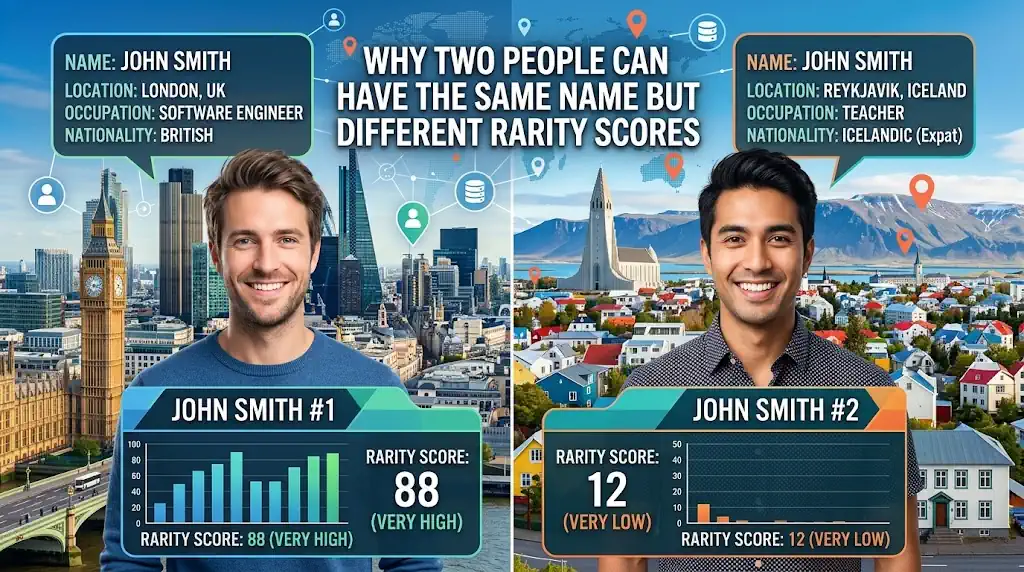
You check your name today and get one rarity score. A friend with the exact same first and last name checks it next month, or on a different site, and gets a noticeably different number. Neither of you did anything wrong, and neither tool is necessarily broken. Here is what is actually happening behind the scenes when identical names produce different rarity results.
Quick Answer
Two people with the exact same name can see different rarity scores because rarity is not a fixed, permanently recorded fact. It is a statistical estimate that shifts based on which data year is used, how recently the population figure was updated, whether age adjustments are applied, and which specific tool or methodology generated the score. Small differences between checks are normal and do not mean either result is wrong.
Rarity Is a Snapshot, Not a Permanent Number
The biggest misconception about rarity scores is that they represent one unchanging fact about a name, similar to a birthdate or a fixed record. In reality, a rarity score is a snapshot calculated at a specific moment using the most recent data available at that time. Population totals shift daily, birth data updates annually, and surname data refreshes roughly once a decade. A rarity score generated in January and the same search run in July can genuinely differ, simply because the underlying numbers feeding the calculation are not static.
The Main Reasons Scores Differ
Different data collection years. Census surname data is only released about once every ten years, while first name data from the Social Security Administration updates annually. If one check pulled from a slightly older data release than another, the resulting percentages, and therefore the final score, will not match exactly.
Population figure updates. Every rarity calculation multiplies a name’s estimated frequency rate against the total US population. Since the population changes constantly, even a small shift in the population figure used can nudge the final headcount and percentile up or down slightly.
Age adjustment methods. Some tools adjust first name data to reflect only people estimated to still be alive today, using life expectancy tables applied to birth year data. Other tools use raw cumulative birth counts without this adjustment. Both are valid approaches, but they produce different results for the same name, especially for names that were far more or less common decades ago than they are now.
Rounding and confidence ranges. Because these are statistical estimates rather than exact counts, most tools round results or present a range rather than a single precise figure. Two tools rounding at different points, or presenting a midpoint versus a range, can show numbers that look different even when the underlying calculation is nearly identical.
Independence assumption variations. As covered in our breakdown of how name frequency is calculated, most tools assume a person’s first and last name occur independently of each other. Some more advanced tools attempt to adjust for known correlations between certain first names and certain surnames, which can shift the final score compared to a simpler calculation that treats every name pairing as equally likely.
Data suppression thresholds. Both the SSA and Census Bureau suppress exact figures for names below a certain threshold to protect privacy. When a name falls close to this line, different tools may handle the missing data differently, some using the lowest possible bound and others using a modeled estimate, which can produce noticeably different results specifically for less common names.
Why This Does Not Mean the Tool Is Inaccurate
A changing score is actually a sign that a tool is using live, updated data rather than a static number frozen in place years ago. A tool that always returns the exact same score for a name indefinitely is more likely relying on outdated or unchanging data than one that reflects small periodic shifts. Think of it less like a fixed fact and more like a regularly recalculated estimate, similar to how a home value estimate updates over time as market data changes, even though the house itself has not changed.
How to Compare Scores Fairly
If you want to compare rarity scores in a meaningful way, a few practices help.
- Use the same tool for repeat checks rather than comparing across different sites, since methodology differences will always create some variation
- Check the date or data source noted on the results page, if the tool provides one, to understand how current the figures are
- Treat the score as a percentile range rather than an exact rank, since two nearby percentiles can represent a very small practical difference
- Recheck periodically rather than treating a single result as permanent, especially for names near a population threshold where small changes matter more
What a Meaningful Difference Actually Looks Like
Not every difference is worth worrying about. A score moving from the 62nd percentile to the 64th percentile between checks reflects normal data updates and is not meaningful. A score jumping from the 20th percentile to the 80th percentile, on the other hand, usually points to a real methodology difference between tools rather than a small data refresh, and would be worth double checking against the tool’s stated data sources.
Final Thoughts
A shifting rarity score is not a flaw in the system, it is a natural result of estimating something from real, continuously updating public data rather than pulling from one fixed master list. Understanding why the number moves makes it easier to interpret your results with the right amount of context, rather than treating a single check as the final word on how common or rare your name really is.
Frequently Asked Questions
Most likely because the population figure, birth data, or surname data used in the calculation was updated between your two checks, which is normal and expected.
Generally the most recently calculated score reflects more current data, though both are valid estimates based on the information available at the time they were generated.
Different tools may use different data years, different age adjustment methods, or different rounding approaches, all of which can produce slightly different final numbers for the same name.
No single definitive score exists, since rarity is inherently a statistical estimate rather than a permanently recorded government figure. The closest approach is treating results as a reasonable percentile range rather than one fixed number.
Not necessarily. Small fluctuations usually reflect data updates rather than an actual shift in how many people have the name, though genuine long term trends do exist and show up gradually over years, not between two checks a few weeks apart.
Curious how rare your own name is?
See how many people in the US share your first and last name — free, instant, nothing stored.
Try the name tool